Coaching From the Outside In, PA Annie Wildermuth Helps Others Unlock Career Potential
“Coaching has given me the greatest joy I’ve felt professionally”
October 14, 2025
By Dave Andrews
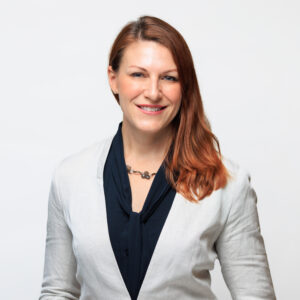
Career versatility and job satisfaction are often considered major advantages of the PA profession. But for many providers, recognizing and seizing career-enhancing opportunities can be easier said than done.
Sometimes, navigating a challenging workplace or career transition requires a new way of thinking. That’s exactly what Annie Wildermuth, PhD, PA-C, EM-CAQ, RD, ACC, offers through her work as an International Coaching Federation associate certified coach. Over the past three years, she has been helping individuals and organizations—both inside and outside of healthcare—build leadership skills and realize untapped potential.
“Coaching has given me the greatest joy I’ve felt professionally,” said Wildermuth, who also serves as vice president of medical education at the American Association of Colleges of Osteopathic Medicine, in addition to her coaching role as co-founder of First Road Leadership Solutions.
[See Wildermuth and other PAs who go beyond on AAPA’s new Nationwide PA Impact Map!]
“It’s an opportunity to help people in a way that I previously didn’t know how to do,” she continued. “It’s opened a way for me to talk to students, providers, administrators and other leaders about the problems they’re facing in a way that’s truly helpful to them.”
Supporting Growth and Preventing Burnout
With individual clients, Wildermuth frequently works on strategies for entrepreneurship, making career pivots, building leadership skills, or addressing burnout. When working with larger groups or institutions, she often focuses on strengthening collaboration among leaders, navigating change, and improving staff retention.
Rather than offering prescriptive advice, Wildermuth emphasizes a creative, client-driven approach.
“My role in coaching is not to tell people the answers to their problems,” she said. “It’s more about helping them think creatively about possible solutions. They’re the experts; I’m helping them think about things differently.”
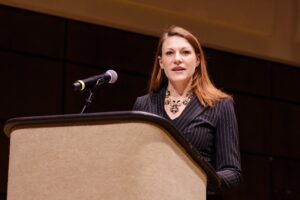
Wildermuth understands many of the pressures her clients face—because she’s faced them herself. She began her career in emergency medicine, practicing full-time for five years before transitioning into primarily educational, administrative, and leadership roles. She has also navigated being the “firs” PA hired in several different settings, and learned that charting a course comes with unique challenges, opportunities, and new perspectives.
“More and more people are looking for strategies to combat the burnout epidemic in healthcare,” she said. “We not only have to do a better job of supporting people, but we have to find different ways of changing the healthcare worker experience.”
A Foundation in Service
Much of Wildermuth’s leadership foundation was built through work with military-affiliated programs. She served as the U.S. military’s Interservice Physician Assistant Program civilian liaison, partnering with the Department of Defense and other federal agencies to support military healthcare training.
That experience deepened her connection to service members, and led to additional opportunities to support service members and veterans. She later became an associate professor at the Uniformed Services University School of Medicine, where she helped military clinicians enhance their leadership skills.
“That was an amazing experience getting to work with the whole realm of healthcare professionals—dentists and PAs, physicians and nurse practitioners,” Wildermuth said. “It’s exciting to help providers at pivotal points in their careers where they are taking on larger roles in teaching, leadership and research.”
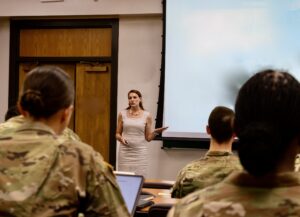
Wildermuth says she relishes the times when there is overlap between her role as a coach and supporting service members. “Coaching military medical students really fills my cup because it dips into two of the things I love to do the most.”
The Power of an Outside Perspective
Although Wildermuth has close family ties to the military—her grandfather and her husband served in the Army and Navy, respectively—she has not served, herself. Still, she believes that being an outsider can offer a valuable perspective, especially in settings where groupthink can limit innovation.
“Sometimes folks, regardless of the setting, are only engaging with others who are experiencing the exact same situations and processes,” she said. “In those scenarios, it can be extremely difficult for them to envision a different approach.”
Maj. Ryan Hunton, DMSc, PA-C, director of PA residency programs and assistant professor at the University of Kentucky, shares that view. With years of experience in both military and academic settings, he found that consulting with Wildermuth helped him shift his mindset.
“She and I talked a lot about how to make an impact and change culture, not only in academia but also in the military,” Hunton said. “To be able to do that, it’s a lot easier when you’re on the outside and can look in to see what could be fixed. That’s really hard to do when you’re the one who is in the thick of it.”
Wildermuth brings that same outsider perspective to her healthcare clients. Even with extensive clinical and administrative experience herself, she is able to help organizations and individuals view challenges in a new light.
“I think that an outside perspective is actually the best perspective,” said Courtney Titus, PA-C, director of the Clinical Pathways Program at Johns Hopkins All Children’s Hospital.
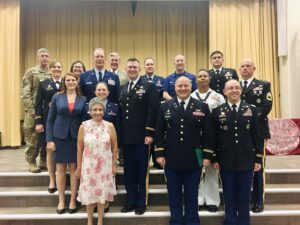
“When you’re inside a health system, the answer is often, ‘Well, we’ve just always done it that way.’ Sometimes it takes a fresh set of eyes to help tackle an issue that you’ve been mulling over for several weeks or months,” Titus said.
Real-Time Problem Solving
When she began working at Clinical Pathways, Titus admits she initially felt “a little lost” in her role. She had hoped to enroll in a mentorship program to help get her bearings, but she struggled to find one relevant to her position.
So she sought the coaching services of Wildermuth, whom she had met at an AAPA conference. Through a series of one-on-one sessions, Titus gained clarity and direction.
“Annie is really good at not only identifying a problem in a short amount of time, but also working through potential solutions and helping me create action items,” Titus said.
“A lot of people out there can identify problems, but not everyone can help you find a solution. I think that’s one of Annie’s greatest strengths.”
For Wildermuth, coaching is about more than providing professional development—it’s about helping people reframe their challenges and rediscover their own agency.
She says her approach is grounded in listening, curiosity, and a firm belief that people already have what they need to succeed. Sometimes, they just need space and support to move forward.
You May Also Like
PA Jared Wallace Aims to Change the Trajectory of Diabetes in the Rural Community of Kenai, Alaska
Early-Career PA William Lara Aims to Provide Care to the Underserved Community in Rural Nevada
PA April Gulotti is Making an Impact on the Global Water Crisis
You might also like
Thank you for reading AAPA’s News Central
You have 2 articles left this month. Create a free account to read more stories, or become a member for more access to exclusive benefits! Already have an account? Log in.