PA’s Award-Winning Research Illustrates a Shift in Emergency Department Utilization
“There are still a lot of opportunities to do objective research on PAs to hopefully support what we are doing and potentially improve how we do it”
March 6, 2026
By Dave Andrews
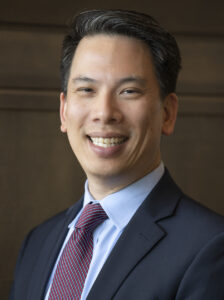
The high-pressure environment and unpredictability of emergency medicine are exactly why Fred Wu, PhD, PA-C, has spent his entire 21-year career in the specialty. For Wu, there is rarely a dull moment in the emergency department—particularly as he has seen his role, and that of his physician associate colleagues, evolve and expand over time.
With the profession continuing to grow, Wu set out last year to better define how PAs are actually utilized in emergency departments across the country.
“In recent years, I’ve noticed more and more physician groups talking about PA utilization, particularly in the emergency department,” said Wu, who serves as lead advanced practice provider (APP) in the emergency medicine department at the University of California San Francisco (UCSF) Fresno, where he also directs the PA residency program.
“I wanted to present objective data on PA utilization, instead of continuing those discussions that are mostly subjective,” he said.
Wu chose the topic as the focus of his doctoral research while completing his PhD in health sciences at the University of South Dakota.
Drawing primarily from the National Hospital Ambulatory Medical Care Survey—a comprehensive dataset published by the Centers for Disease Control and Prevention—Wu identified several key insights from a sample of approximately 500 hospitals nationwide.
He analyzed data from 2018 to 2022, examining patient demographics, insurance types, visit timing, and acuity levels. He then focused on trends in emergency department visits by provider type, comparing PA-only visits with physician-only visits and visits involving both a PA and a physician.
A Surprising Discovery
Before analyzing the data, Wu assumed PA utilization had increased—an impression shaped by his own professional experience. However, he said he was “very surprised” to learn that was not the case from a national perspective.
While overall emergency department visit volume rose by about 20% during that period, PA-only visits declined. Meanwhile, visits involving both a physician and a PA increased.
“When we hear some physicians saying PAs are taking over and PAs are increasingly seeing their patients all on their own, that isn’t quite true based on this objective data,” Wu said.
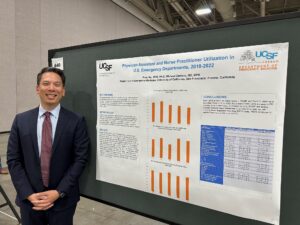
His analysis showed that physicians remained involved in the vast majority of emergency department visits. Additionally, the odds of high-acuity patients being seen during a PA-only visit decreased during the study period.
“PAs are obviously seeing a good number of patients, but they are not seeing the higher acuity patients that some groups might think they are,” he said. “PAs are typically seeing younger patients, and from 2018 to 2022, there was, in fact, an increase in team-based [PA with a physician] visits.”
Award-Winning Results
In recognition of his work examining PA utilization trends, Wu was named the 2025 recipient of the Physician Associate Foundation’s Breitman-Dorn Endowed Research Award. Established in 1998 to encourage research on the PA profession and the influence of PAs on medical care, the award recognizes work that contributes meaningful insight to the field.
Wu had learned about the award, offered annually through PAF’s funding cycles, years earlier, but it wasn’t until the final year of his doctoral program that he realized he was eligible to apply. “I was already in that dissertation phase, so the timing could not have been more perfect,” he said.
Unlike many research honors, the Breitman-Dorn Research Award provides a cash award rather than a grant, giving recipients flexibility in how they use the funds.
“It’s a great way to pay for tuition, school expenses, or anything else, such as funding the research because there are a variety of costs involved,” Wu said.
Beyond the financial support, Wu is especially appreciative of the visibility the award brings to both his research and the specialty.
“I love that it brings attention to the research PAs are doing,” Wu said. “For me, this award is a great way to get my research out there and to say, ‘Hey, this is something that’s not only important to me, but it’s important for emergency medicine. You should check it out.’”
The Work Continues
Wu plans to publish his findings soon and is already considering future research topics to further explore the evolving role of PAs in emergency medicine. For him, the study is not a conclusion but rather a starting point that will prompt deeper examination of the profession’s impact on patient care.
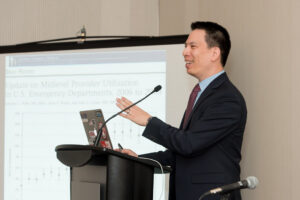
“My hope is that this will help drive further research because there are things that this particular dataset doesn’t tell us, such as quality of care, cost, or patient outcomes, all of which are very important factors,” he said.
Those unanswered questions are exactly what continue to motivate him. While utilization patterns are important, Wu believes the next phase of research must focus on outcomes and value, speaking more to the broader conversation about the future of healthcare delivery.
At the core of everything Wu does—whether in the emergency department, the classroom, or the research arena—is a deep commitment to the PA profession. He says he remains inspired by the flexibility, collaboration, and growth potential PAs can enjoy throughout their careers, and he is committed to advancing the profession in every way he can.
That commitment extends beyond clinical practice and into building a stronger evidence base for the field.
“There are still a lot of opportunities to do objective research on PAs to hopefully support what we are doing and potentially improve how we do it,” Wu said.
That mindset reveals how his approach to care has evolved throughout his career. Early on, Wu focused solely on his clinical practice—research was not part of his original plan. But as his experience grew, so did his curiosity about long-standing practices and assumptions within medicine.
“I will often wonder, ‘We’ve done something a certain way for so long; is it still the best way?’ said Wu. “Perhaps the answer is yes, but only through research will we know for certain. That’s what drives me to investigate these important topics.”
About the Physician Associate Foundation
The Physician Associate Foundation (PAF), established in 1977, is a national nonprofit organization dedicated to promoting better health and wellness by connecting the clinical expertise and compassion of PAs with community healthcare needs. As the philanthropic arm of AAPA, PAF provides PAs and PA students with philanthropic opportunities and resources — including grants, scholarships, and awards — and works to positively impact the lives of PAs, students, their patients, and the communities they serve. PAF’s mission is to empower PAs to improve health through philanthropy and service. For more information, visit pa-foundation.org.
You May Also Like
2025 Publishing Award Recipient Examines the Effect of a Doctoral Degree on PA Graduates
From Physical Therapist to Physician Associate: Darvin Foo Found New Fulfillment
PA Bryn Kroto is Making an Impact on Global Health
You might also like



Thank you for reading AAPA’s News Central
You have 2 articles left this month. Create a free account to read more stories, or become a member for more access to exclusive benefits! Already have an account? Log in.