PA Sutton Became the First Altruistic Living Kidney Donor in South Carolina, and Now Leads the South Carolina Transplant Foundation
Zachary Sutton is a strong advocate for organ transplantation and is dedicated to spreading awareness on its benefits
August 1, 2025
By Jennifer Walker
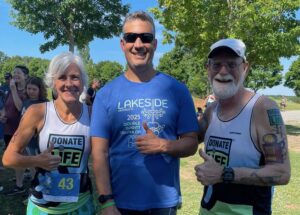
Nonprofit leader Zachary Sutton, DHA, MS, MSPAS, PA-C, DFAAPA, FACHDM, is committed to spreading awareness about kidney disease and organ transplantation. In 2008, he became the first altruistic living kidney donor in South Carolina when he donated a kidney to Michael Cheeks, a man who had been on dialysis for 15 years.
After Cheeks passed away 12 years later, Sutton became a fierce advocate for kidney disease awareness and co-founded of the South Carolina Transplant Foundation. The foundation provides education, financial assistance, and supportive services to organ transplant patients. In June 2025, the foundation sponsored the inaugural National Kidney Donor Triathlon to spotlight the life-saving impact of living organ donors nationwide.
“Everything changed when I found out what happened to my recipient,” said Sutton, who is also the transplant program coordinator at Carolina Nephrology in Greenville, South Carolina. “I don’t like getting in front of people or putting myself on the spot. But I have to because there are people like my recipient who do not have a voice. So I make his voice my voice.”
[See Sutton and other PAs who go beyond on AAPA’s new Nationwide PA Impact Map!]
Since 2024, the South Carolina Transplant Foundation has raised approximately $80,000 through events and individual donations. This money has been used to support about 70 kidney transplant patients, funding hotels, food, and transportation—the hidden costs of organ transplantation. Their goal is to provide support to 300 patients a year, half of the total number of people who receive kidney transplants in South Carolina annually.
Becoming a Living Kidney Donor
Sutton has a family history of kidney disease. His mother has suffered from the disease for over 30 years, and his grandmother was on renal dialysis and passed away the day of Sutton’s graduation from Clemson University, when he received his bachelor’s degree.
Shortly after graduating, Sutton began volunteering with Donate Life South Carolina. He traveled to biking and running events to encourage people to become donors, both in their lifetimes by donating a kidney, a portion of their liver, bone marrow, or blood; or by agreeing to donate their organs after death.
Then, in 2007, Sutton, who had left his PhD program a couple of years prior, was about to start the PA program at the Medical University of South Carolina (MUSC). A few months beforehand, he went to the transplant office on campus and asked if he could shadow a transplant. He sat in on a living donor nephrectomy. There, he watched the donor kidney immediately produce urine after it was hooked up, knowing the procedure would be life-changing for the recipient.
That experience, he said, was a call to action that made everything click. “I have that personal history with kidney disease. Maybe becoming a living donor was what I was meant to do,” he said.
After completing his PA exams in 2008, Sutton donated his kidney to Cheeks. The day before the transplant, Cheeks told the Post and Courier that he was speechless and nervous. “I’m still taking it all in. It’s really overwhelming, just to get my life back.”
On Sutton’s end, the surgery took a couple of hours. Afterward, he was sore but able to return to long-distance walks in only a few weeks. “It’s not something to blow through. It’s a little scary. But at the same time, I’ve been blessed with my position in life—my parents, my background—and I have a voice. And I decided to use it for Michael to support transplant.”
Starting the South Carolina Transplant Foundation
The South Carolina Transplant Foundation is modeled after a similar foundation in Georgia, which provides financial assistance to families undergoing organ transplantation. “We kept saying, ‘Somebody should do this for South Carolina,’ and it finally took us to do it,” said Sutton, who co-founded the foundation with transplant social worker Samicca Berry.
Most transplant programs require patients to raise $1,000 to cover outside costs associated with transplant procedures, Sutton said. But this requirement can deplete patients’ savings during a difficult time. To ease that burden, the foundation provides up to $400 for each patient. Patients are referred to the foundation through their social worker, and they submit receipts to show how they have spent the money.
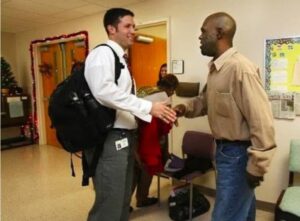
Sutton rarely comes into contact with patients who receive this funding. But once at his clinic, he happened to meet a man who had a kidney transplant and had received support from the foundation. “He expressed to me that the transplant was a second lease on life, and he felt very grateful for it, but saving the money was hard,” Sutton said. “He was watching all of his money go away for the first couple of months. But through the foundation, he knew that someone was there and he could get the money back. He thought that was amazing, that we would be willing to do that for him.”

Sponsoring a Triathlon for Living Kidney Donors
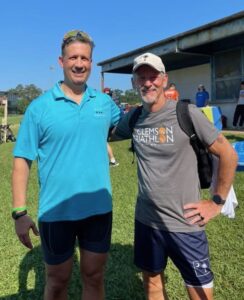
In June 2025, Sutton sponsored and participated in the first National Kidney Donor Triathlon, which was organized by the South Carolina Transplant Foundation and advertised by the National Kidney Registry in partnership with the Clemson Triathlon. The course—which included a 1,000-meter swim, a 21k bike ride, and a 6k run—took place in and around the Clemson University campus.
Eleven living donors ran in the individual category, and Sutton placed second in his age group. There were also two relay teams, one with a living donor and one with a heart transplant recipient. The National Bone Marrow Registry was also on-site to register people to be potential donors. Two people registered as organ donors and one person showed interest in donating a kidney.

Sutton’s goal is for the triathlon to be its own event, one that might eventually be part of the national Donor Games, a group of in-person and virtual fitness competitions for living kidney and liver donors. He also hopes to draw in a large group from Kidney Donor Athletes, which builds community among living kidney donors. “We would like to make this a reunion and have a large group of 50 or 60 kidney donors,” he said.
Sutton also wants to continue to encourage others to look into the many ways to support organ transplantation. “You don’t have to give a kidney,” he said. “Maybe it’s giving blood or financial assistance, or maybe it’s clicking a ‘like’ on a Facebook post. But we need to educate people. A lot of groups in our society—whether it’s the elderly or minorities, or people who have genetic conditions or who are lower income—are disproportionally affected by kidney disease. We have to raise awareness about that, and transplants are part of the story.”
You Might Also Like
PA Donates Kidney to 2-Year-Old Boy with Rare Disorder
Transplant Surgery Helps PA Turns Tragic Endings into New Beginnings
PA Olivia Bell Celebrated the 25th Anniversary of Her Open-Heart Surgery by Running the New York City Marathon
You might also like



Thank you for reading AAPA’s News Central
You have 2 articles left this month. Create a free account to read more stories, or become a member for more access to exclusive benefits! Already have an account? Log in.